Showing posts with label E-Waste. Show all posts
Showing posts with label E-Waste. Show all posts
Monday, November 15, 2010
So Simple Even a Child Can Understand It
E-Waste
The Story of Electronics at The Story of Stuff Project
Ghana - Digital Dumping Ground
More on the subject at the Lair
.


Saturday, October 28, 2006
Recycled Your Computer? Guess Again!
By Bluebear2
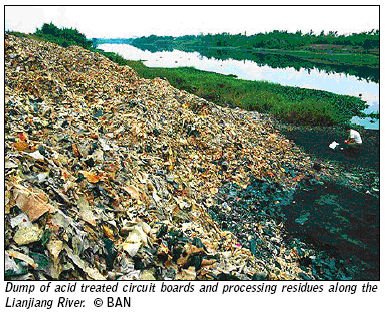
You're green, you recycled your old computer. But where did it go?
Owners of computers, monitors, printers, digital cameras, TVs and other such electronic items may think they are doing a good deed and protecting the environment when they recycle them, but most often that is not the case.
In a report by the Inter Press Service News Agency, Greenpeace claims the export of toxic waste from industrialized countries to third world countries is occurring on a regular basis. Inspections were performed at 18 European seaports in 2005 and it was found that 47% of waste bound for export was illegal. It is estimated that 23,000 metric tons of illegal wastes came from Great Britain alone, bound for South-East Asia, India, Africa and China.
And it is further claimed:
So what is in these items that is so dangerous?
The Exporting Harm report, among other things, lists such highly toxic elements as lead, cadmium, mercury, beryllium and brominated flame retardants.
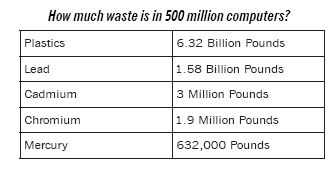 This chart lists some of the most common items in a computer and the amount used.
It can easily be seen that this is a huge problem which needs a safe resolution.
And these are just a few of the components to be concerned about.
Where is this problem?
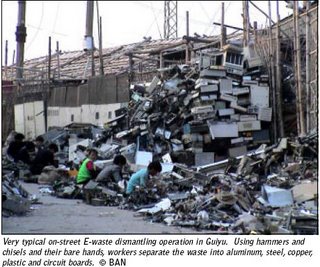
China is one place where in some small towns this waste lines the streets as people pick it over to remove as much of the valuable material as they can.
They bathe the motherboards in acid. Melt the solder off with torches and just plain pry parts loose with their hands. All the time exposing themselves to fumes and skin absorption of these toxins.
Often times these people are children as well as adults.
The remaining items are burned in the open air.
When burned, the plastics can give off dioxins --
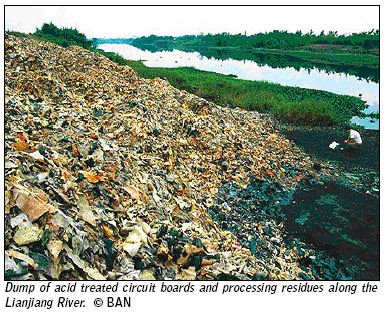
 some of the most poisonous substances known. Also the rain falling on the toxic remnants pollutes ground water and rivers, yet more sources of health problems.
Technology Reports puts it this way:
 The Basel Convention attempts to solve the problem.
The Basel Convention was adopted in Basel, Switzerland in 1989 and went into force in 1992. Its purpose was to regulate the movement of toxic waste materials.
TWN reports that at a later meeting, the Basel Convention on Transboundary Movement of Hazardous Wastes, over 100 countries signed on to ban all transfer of hazardous wastes for disposal, recycling or recovery.
Immediately after the meeting Greenpeace, having lobbied long for this agreement, gave a press release:
The US is a major holdout on the agreement.
The United States has not signed on to this agreement and refuses to do so as noted in the TWN article.
In this report by Greenbiz there are some reasons to have hope.
On Feb. 25, 2003, the one year anniversary of the "Exporting Harm" report:
Also, both California and Massachusetts have banned these items from their landfills.
You're green, you recycled your old computer. But where did it go?
Owners of computers, monitors, printers, digital cameras, TVs and other such electronic items may think they are doing a good deed and protecting the environment when they recycle them, but most often that is not the case.
In a report by the Inter Press Service News Agency, Greenpeace claims the export of toxic waste from industrialized countries to third world countries is occurring on a regular basis. Inspections were performed at 18 European seaports in 2005 and it was found that 47% of waste bound for export was illegal. It is estimated that 23,000 metric tons of illegal wastes came from Great Britain alone, bound for South-East Asia, India, Africa and China.
And it is further claimed:
In the
To get past Environmental Protection Agency regulations, vast quantities of recycled materials are separated domestically and then transferred through a difficult-to-trace series of buyers, sellers and brokers. Ultimately, they arrive … in impoverished cities in China, Pakistan and India, where cheap labor means every last screw can be salvaged and sold back to manufacturers.In a report titled Exporting Harm -- The High-Tech Trashing of Asia it is estimated that in the ten year span from 1997-2007 the United States will have generated over 500 million obsolete computers.
So what is in these items that is so dangerous?
The Exporting Harm report, among other things, lists such highly toxic elements as lead, cadmium, mercury, beryllium and brominated flame retardants.
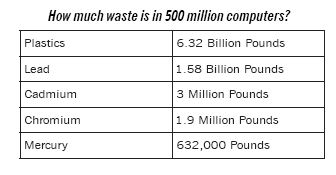 This chart lists some of the most common items in a computer and the amount used.
It can easily be seen that this is a huge problem which needs a safe resolution.
And these are just a few of the components to be concerned about.
Where is this problem?
China is one place where in some small towns this waste lines the streets as people pick it over to remove as much of the valuable material as they can.
They bathe the motherboards in acid. Melt the solder off with torches and just plain pry parts loose with their hands. All the time exposing themselves to fumes and skin absorption of these toxins.
Often times these people are children as well as adults.
The remaining items are burned in the open air.
When burned, the plastics can give off dioxins --
 some of the most poisonous substances known. Also the rain falling on the toxic remnants pollutes ground water and rivers, yet more sources of health problems.
Technology Reports puts it this way:
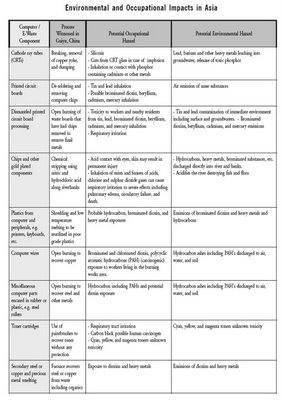
Additional detrimental effects are listed in the following chart. (If you double-click on the chart it should open in a new window where you can enlarge it. It can also be found in the "Exporting Harm" report linked above.)...80 percent of the consumer electronics ostensibly recycled through local organizations, is headed for one of the most impoverished villages in the world, welcomed by the population because disposal of the Western waste provides income and work for the local residents.
However, these abandoned consumer electronics do more than just help support the economy. The computers, mobile phones, digital cameras and MP3 players are veritable construction kits of noxious chemicals, the destruction of which can trigger asthma attacks, respiratory infections, emphysema, cancer, blood and brain disorders and liver damage.
Developing countries are littered with First World electrical detritus; the streets of exotically-named cities like Taizhou and Guiyu are lined with mother boards, graphics cards and deadly CRTs piled in mountains held together with insulated wire, micro-chips and glass.
 The Basel Convention attempts to solve the problem.
The Basel Convention was adopted in Basel, Switzerland in 1989 and went into force in 1992. Its purpose was to regulate the movement of toxic waste materials.
TWN reports that at a later meeting, the Basel Convention on Transboundary Movement of Hazardous Wastes, over 100 countries signed on to ban all transfer of hazardous wastes for disposal, recycling or recovery.
Immediately after the meeting Greenpeace, having lobbied long for this agreement, gave a press release:
Greenpeace Policy Advisor and representative at the COPs, Dr Kevin Stairs, said that despite “an onslaught of tricks and bad faith negotiations by a handful of countries, the global community has refused to accept a future for toxic colonialism and has agreed on a real ban.… At last the loophole of being able to export hazardous waste under the guise of recycling will be eliminated, thus beginning a new era to promote waste prevention and clear production…. This will finally force the rich countries to take full responsibility for their hazardous waste production problems instead of dumping it on their neighbors. This was the original intent of this convention, and now it is fully a part of it.”This is good news and when fully implemented it should help solve this issue, except for one not so small problem.
The US is a major holdout on the agreement.
The United States has not signed on to this agreement and refuses to do so as noted in the TWN article.
The United States has not yet ratified the Basel Convention and has been at the forefront of moves to enable “export for recycling” -- a subterfuge to export wastes, including household and municipal wastes and garbage, whose final disposal in landfills inside the country is opposed by local communities.The "Exporting Harm" report also comments on the United States’ position.
The report goes on to say:It is sadly ironic that the United States was the first country in the world to recognize and uphold the principle of environmental justice. This principle asserts that no people, based on their race or economic status should be forced to bear a disproportionate burden of environmental risks.
The current U.S. policy of encouraging the quick and dirty route of export, hidden under the green cloak of the word “recycling”, is not only an affront to environmental justice but also to the principles of producer responsibility, clean production and pollution prevention.
At least some American companies and states are stepping up to the plate.As long as manufacturers can evade the ultimate costs of their hazardous products via export to Asia, they can delay aggressively deploying their ingenuity to make sure their products are less toxic and burdensome to the planet.
In this regard, with little incentive, the electronics industry in the United States has, for the most part, moved at a snail’s pace in preventing the problem at the source through green, toxic-free, recyclable design. Instead, thanks to the convenient
pipeline of export, industry, aided by government, has taken a head-in-the-sand, business-as-usual, for-as-long-as-possible approach.
In this report by Greenbiz there are some reasons to have hope.
On Feb. 25, 2003, the one year anniversary of the "Exporting Harm" report:
Sixteen private electronics recycling firms representing 22 facilities throughout North America have pledged to uphold rigorous environmental and social criteria for the dismantling and recycling of e-wastes.To assist in this situation the State of California has started charging a fee on the sale of new computers to help defray the costs of truly and safely recycling these old electronics.
Under the banner of “No Export, No Dumping, No Prisons” the signatory companies have all agreed, among other requirements to:
* prevent hazardous e-waste from going to municipal incinerators or landfills
* prevent the export of hazardous e-waste to developing countries
* use free-market rather than prison labor to dismantle or recycle e-waste
The criteria are contained in the landmark "Electronic Recycler’s Pledge of True Stewardship” was developed in conjunction with members of the Computer TakeBack Campaign, including the Basel Action Network, and the Silicon Valley Toxics Coalition.
Also, both California and Massachusetts have banned these items from their landfills.
Subscribe to:
Posts (Atom)